
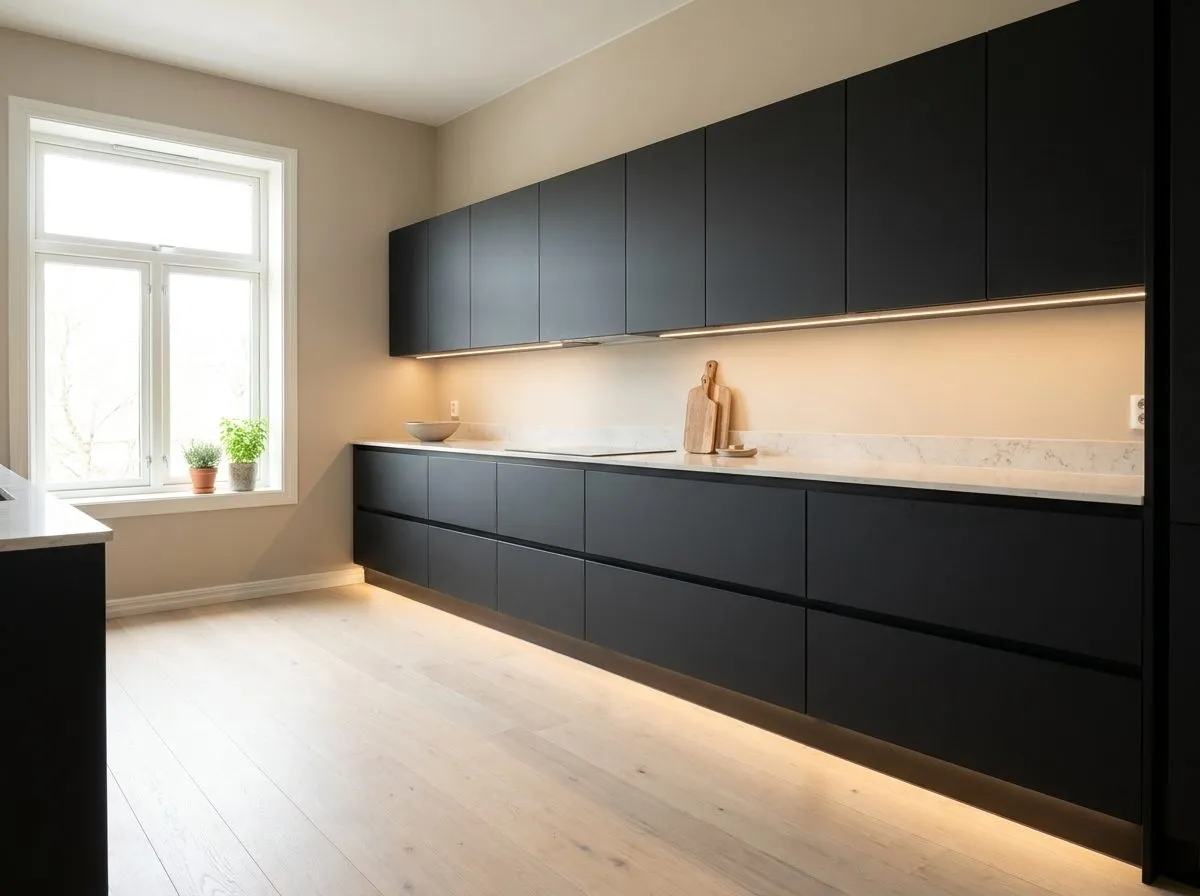
Strip the marketing and the framed-vs-frameless question is about one strip of wood — the face frame around the box opening — and what removing it buys: wider drawers, fuller access, flatter faces. Here is the practical version, in inches rather than adjectives.
What is structurally different?
A framed cabinet wraps its opening in a face frame; doors hinge to the frame, and the frame lip narrows what you reach through. A frameless box — the European construction — mounts doors directly to the sides: the full interior width is yours, drawers run wider in the same footprint, and the finished kitchen presents an unbroken plane of doors. The oak install in the photo above shows the trade-off’s other side mid-build: with no frame to square the run, frameless demands flat walls and patient leveling — installer discipline is part of the spec.
| Framed | Frameless | |
|---|---|---|
| Opening | Narrowed by the frame lip | Full width, full access |
| Drawer width | Loses to frame clearance | Wider in the same box |
| Look | Traditional to transitional | Flat, continuous, modern |
| Inset option | Yes — its natural habitat | No — inset needs a frame |
| Install tolerance | Frame forgives small wall sins | Demands flat and level |
Where do the lost inches go?
The frame lip costs usable width at every opening, and drawer boxes lose more to hinge and frame clearances. An inch and change per cabinet sounds like nothing until you multiply by a dozen boxes — in a compact kitchen, frameless construction can return roughly a cabinet’s worth of capacity without moving a single wall, which pairs naturally with the other small-kitchen fixes we rank.
One caveat keeps the comparison honest: with no frame sharing the load, the box carries everything. Frameless in particleboard is how sagging shelves happen — the construction argument circles straight back to plywood boxes.
Which style of kitchen does each serve?
Framed construction is the home of traditional and transitional kitchens — and the only home of inset doors, which need a frame to nest into. Frameless serves the modern end: slab and handleless fronts, continuous grain runs, minimal reveals. Shaker doors happily live on either construction, which is why the box question and the door question deserve separate answers in your quote.
What we’d tell a friend
Decide by the kitchen you want to see and the storage you need to win. If inset doors or traditional detail are the goal, framed is the answer by definition. If drawers, access and a flat modern face are the goal, go frameless — in plywood, installed by a crew that levels obsessively. Both constructions sit side by side at our Roswell showroom; opening the same size box in each settles the inches argument in person.