
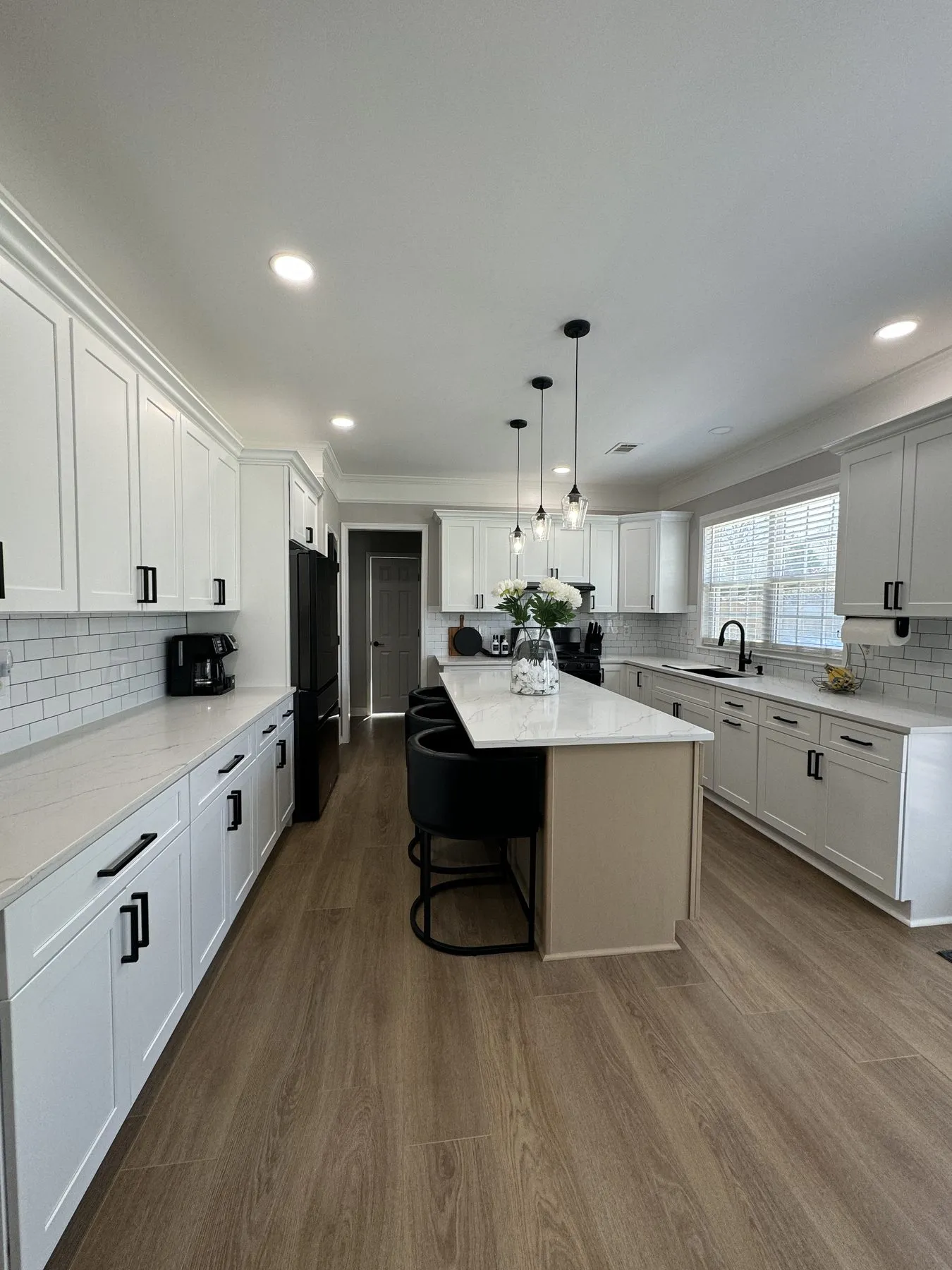
Most door-style decisions come down to three candidates, and they differ in build, not just looks: shaker (the frame-and-panel classic), slim shaker (the same construction with a narrow frame) and inset (a door fitted flush inside its frame). Here is how we walk homeowners through it at the showroom — usually with the doors side by side, which settles it in about a minute.
What is each door, mechanically?
| Shaker | Slim Shaker | Inset | |
|---|---|---|---|
| Construction | 5-piece frame, flat panel | Same, ~1” narrow frame | Door sits inside the face frame |
| Reads as | Classic, adaptable | Current, tailored | Furniture-grade, traditional |
| Cost logic | Baseline | Near shaker | Highest — hand-fitted reveals |
| Hides wear | Best | Good | Good, but reveals demand precision |
| Hardware | Flat mounting, any pull | Flat mounting, slim pulls | Any, knobs traditional |
The vocabulary trap worth knowing: shaker describes a face, inset describes a mounting. An inset kitchen usually wears a shaker face — the two are answers to different questions.
When does each one belong?
Shaker is the default for a reason. It suits 1990s colonials and new builds alike, survives trend cycles, and paints and repaints without complaint — the kitchen in the photo above pairs white shaker with glass-front uppers and a custom hood, and it will read current in 2035. If you are unsure, this is the safe money.
Slim shaker is for kitchens leaning modern without going handleless. The narrow frame reads lighter from across the room; it rewards quiet counters and simple pulls, and it fights heavy traditional molding — commit to the direction or skip it.
Inset is the tailored suit: flush faces, tight reveals, cabinetry that reads as furniture. It costs more because every door is fitted by hand, and it gives back slightly less interior space to the frame. Nobody buys inset on math; in the right traditional home, nothing else looks finished next to it.
How do you actually decide?
Two questions do most of the work. What does the house want? — a transitional Roswell colonial argues for shaker; a modern Alpharetta build tolerates slim shaker beautifully; a traditional home with original trim is where inset earns its price. And where is the budget’s protected money? — if box construction and installation are funded, the door style is a safe place for taste. If choosing inset would force particleboard boxes, choose shaker and never look back.
What we’d tell a friend
See all three in person before deciding — photos flatten exactly the depth and shadow differences that justify the price gaps. Bring your kitchen photos to a free design session and we will put the two right candidates in your hands; the wrong one usually eliminates itself.