
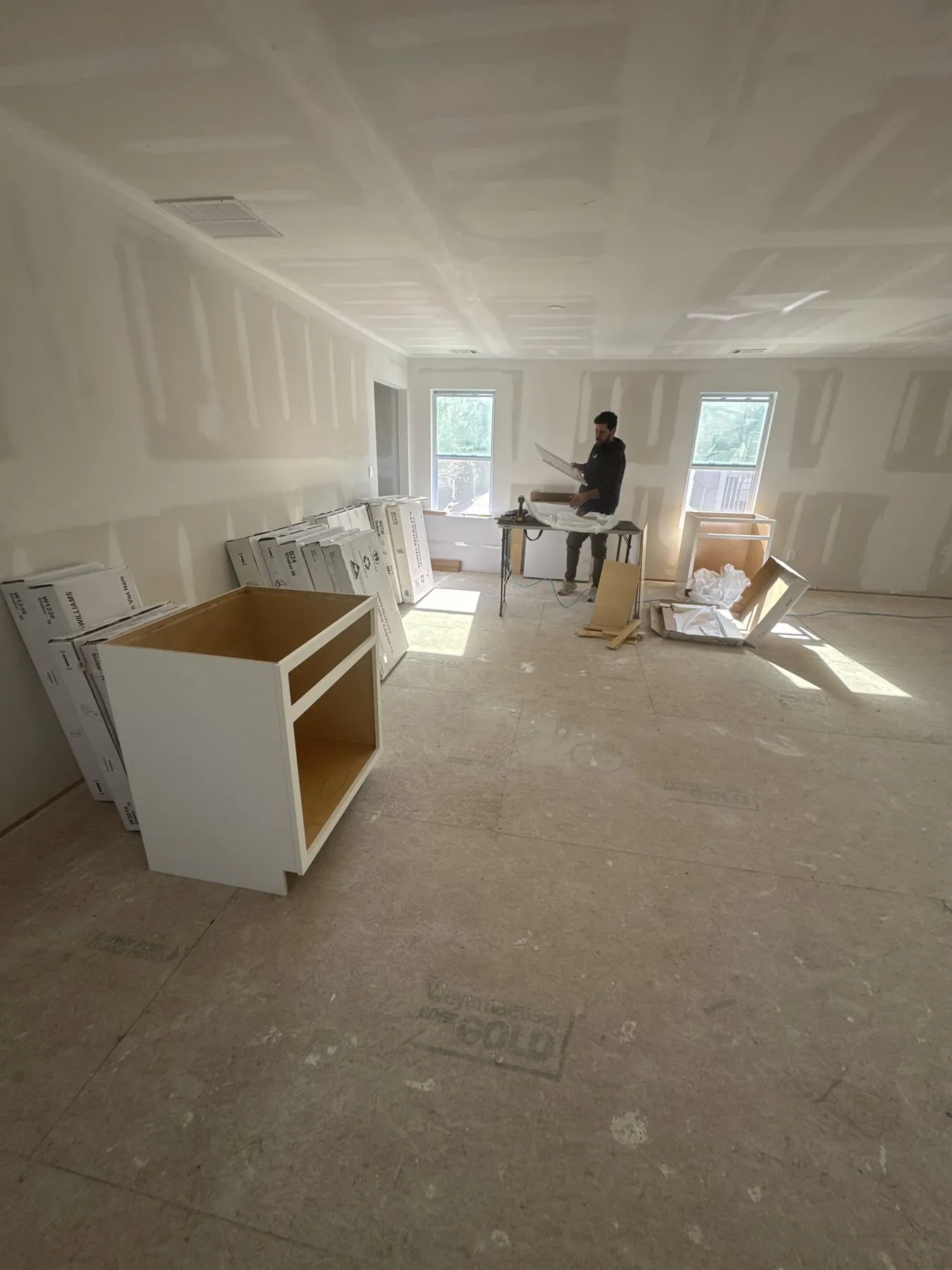
If you remember one thing from this guide: the box matters more than the door. Doors are the face; the box carries the weight, takes the steam and holds the screws for twenty years. Plywood boxes do that best, which is why every line in our warehouse is real wood construction with no MDF — a decision we made before we wrote a single page of this website.
What are the three materials, in plain terms?
| Material | What it is | Strengths | Weak points |
|---|---|---|---|
| Plywood | Thin wood layers glued cross-grain | Screw-holding, moisture tolerance, span strength | Costs more |
| MDF | Fine wood fiber pressed with resin | Smooth paint surface, stable panels | Heavy; swells when water finds a raw edge |
| Particleboard | Coarse chips pressed with resin | Cheapest | Sags over spans, crumbles at fasteners, hates moisture |
Why does humid Georgia raise the stakes?
Cabinet failures we get called to fix rarely announce themselves as “moisture damage.” They look like a hinge screw that will not stay tight, a shelf with a permanent bow under everyday dishes, a swollen seam under a sink after a slow drip nobody caught for a month. Georgia summers keep indoor humidity working on cabinet boxes for months at a time, and under-sink plumbing gives water a direct route to raw edges. Plywood takes that abuse and holds; pressed boards take it personally.
The install crew’s habit tells the story: when our team sets a run of cabinets — like the greige kitchen in the photo above — they routinely stand on parts of the base framing as they work. That is a plywood-box habit.
Where is MDF actually fine?
We are not in the “MDF is garbage” camp — we are in the “MDF is not a box material” camp. In a painted, center door panel, MDF’s smooth face is why some painted doors look glassy while solid wood panels can telegraph grain lines through the paint. What we do not accept is MDF or particleboard as the structure: sides, shelves, backs, drawer boxes. Structure is where the “real wood, no MDF” rule on our cabinet styles applies without exception.
How do you check before you buy?
Three checks take one minute in any showroom. Open a base cabinet and look at a raw shelf edge — layers mean plywood. Press a thumbnail into a hidden edge — particleboard dents and flakes. Ask what the drawer box is made of, because that answer is the honest one; drawers get the hardest daily use. Do the same checks at our Roswell showroom — the contact page has the appointment details.
What we’d tell a friend
Pay the plywood difference on the boxes and, if the budget is tight, save on door style instead — a shaker door on a plywood box will outlast the opposite combination by years. And whatever you buy and wherever you buy it, see a raw edge first. The full cost picture is in our Atlanta cabinet price guide.