
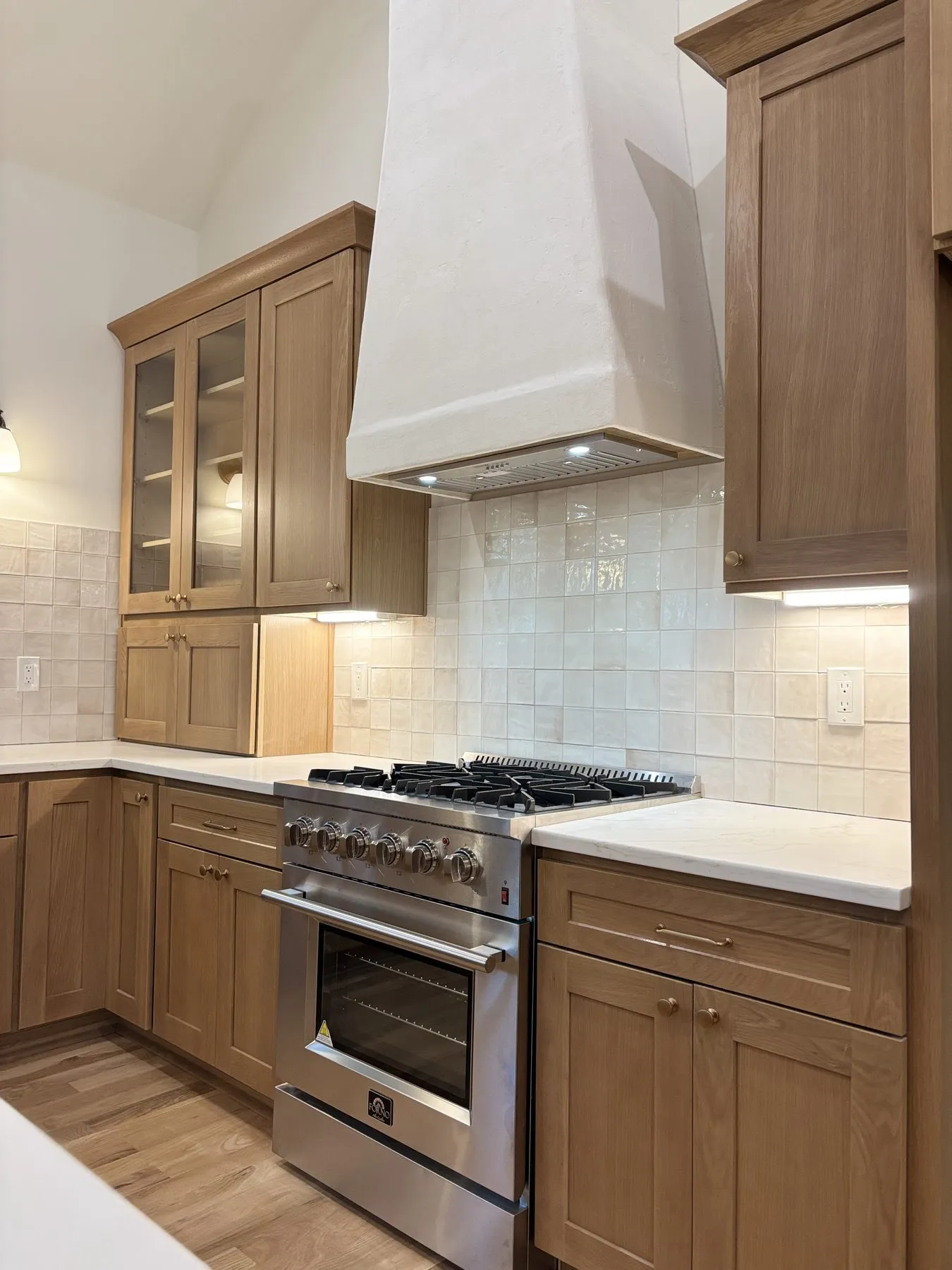
The backsplash-countertop decision runs on one rule: let one surface carry the pattern and make the other one quiet. Every combination that photographs calm follows it; most kitchens that feel “busy but we cannot say why” broke it. Here is the rule applied, using kitchens we actually built.
Pairings from our own installs
| Countertop | Backsplash | Where we built it | Why it works |
|---|---|---|---|
| White quartz, subtle vein | White subway, straight set | The Alpharetta remodel | Pattern lives in the black hardware, not the surfaces |
| White quartz | Gray subway + wood shelves | The finished kitchen above | Tile adds tone, shelves add warmth, nothing shouts |
| Veined quartz | Full-height matching quartz | A recent North Atlanta install | One surface, zero grout — the premium move |
| Speckled granite | Beige tile, diagonal set | The Alpharetta before photo | It does not — two patterns, dated set |
That last row is the cautionary tale worth keeping: the before photo shows speckled granite fighting a diagonal beige backsplash — two patterns, both losing. Demolition day settled the argument.
Straight-set subway: the default that keeps earning it
When a kitchen has any other statement — veined quartz or quartzite, a bold island color, a custom hood — straight-set subway in a near-wall color is the backsplash that lets the statement speak. Grout is the hidden variable: matched grout reads as texture, contrasting grout reads as a grid, and the grid ages faster. If you want interest without pattern, change the tile size (longer, slimmer formats) before changing the layout.
Full-height: when the counter climbs the wall
Running the slab up the wall — as in the full-height quartz detail from one of our installs — deletes grout lines entirely and turns the range wall into one uninterrupted surface. It costs more in material and fabrication, cleans like a countertop, and is the single strongest “custom” signal a kitchen backsplash can send. We spec it most behind ranges, where grout takes the hardest cleaning duty anyway.
The combinations that date fastest
Diagonal sets place a kitchen in its decade with one glance. Four-inch granite stub splashes read as builder-grade leftovers. Accent-tile mosaics strips behind the range were everywhere for a decade and stopped; the kitchens that survive trend cycles keep the pattern count at one and let hardware and color carry personality — both are afternoon swaps, tile is not.
What we’d tell a friend
Choose the countertop first, honestly grade how much pattern it carries, then let the backsplash take whatever attention is left over. Bring one door sample and one counter sample to the tile wall — never choose all three apart. All three surfaces sit together at our Roswell showroom, and the pairing takes minutes with the real materials in hand; the design session puts them in your kitchen’s light.