
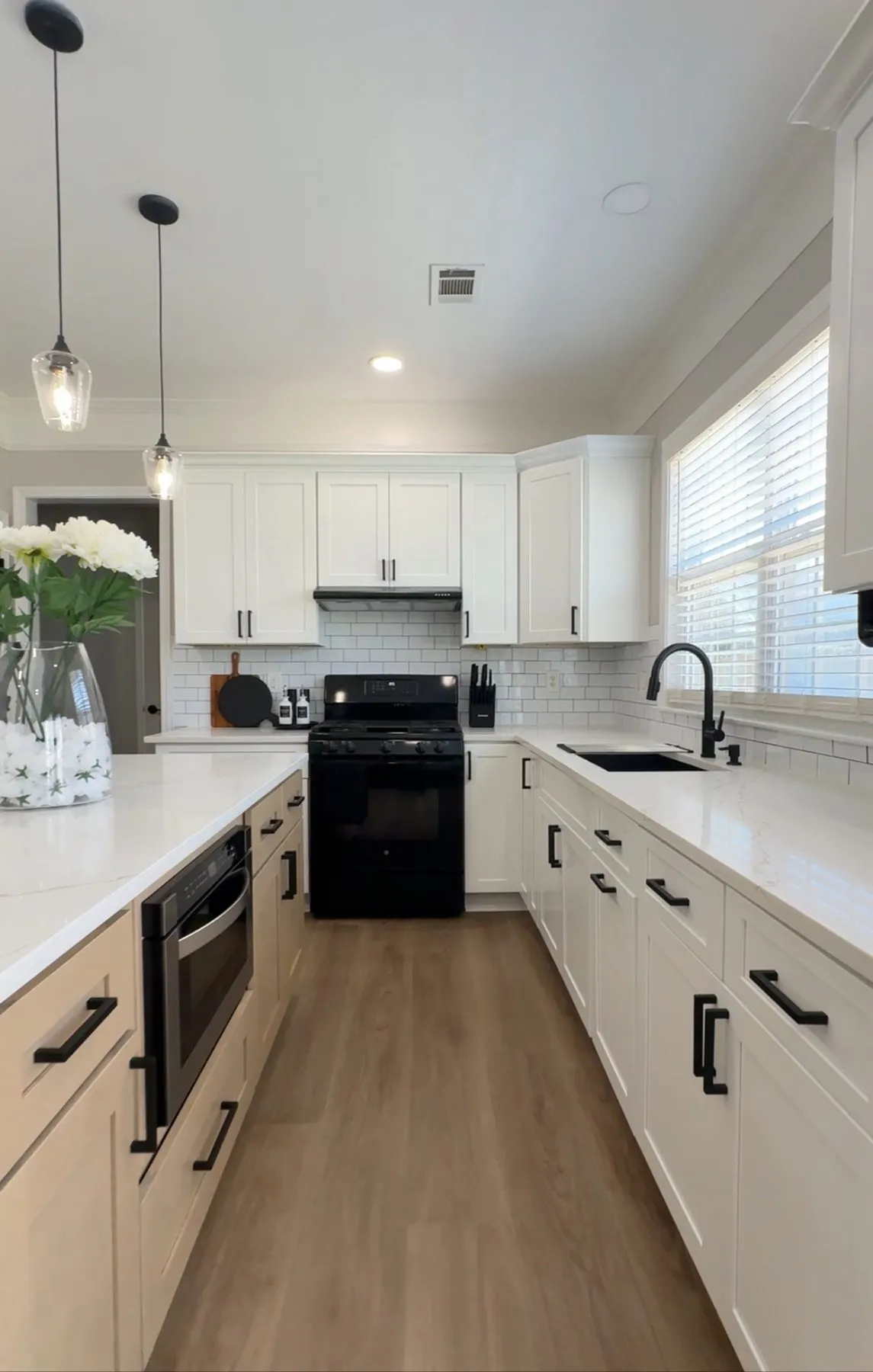
Hardware is the smallest budget line in a kitchen and the one your hands grade every single day. The rules below are the ones our installers actually drill by — including the jig measurements — so your pulls land where knuckles expect them twenty years from now.
The sizing rules
| Element | The rule | Common answer |
|---|---|---|
| Door pulls | ~1/3 of door height feels balanced | 96-128mm centers |
| Drawer pulls | ~1/3 of drawer width | 128mm; 160-192mm on wide drawers |
| Wide drawers (30”+) | One long pull or two standard | Two pulls read traditional |
| Appliance panels | Go big — they carry real weight | 12” and up |
| Knobs | One size fits most | 1.25-1.375” diameter |
Metric centers (96/128/160/192mm) are the industry’s spacing language — worth knowing because replacement hardware must match the drilled centers, which is why we keep drilling to standard centers even on custom cabinets: future-you gets to change hardware without filling holes.
The placement rules our jigs enforce
Doors take hardware at the opening corner, 2.5-3 inches from the corner, centered on the stile — on a shaker door the frame width literally draws the target. Drawers center their hardware left-right; deep drawers carry it on the upper third so you pull with a straight wrist. Tall pantry doors take pulls at standing-hand height, roughly 44-48 inches off the floor, not centered on the slab. The jig is the point: eyeballing forty holes produces forty opinions, and hardware misalignment is the kind of flaw you cannot un-see across a finished run.
Finish: pick one metal and let it work
The kitchen in the photo above — the Alpharetta remodel — runs matte black on every pull, faucet and fixture, and that single-metal discipline is most of why it photographs so calmly. Mixing metals can work with intent (brass hardware, black faucet, consistently applied); drifting into three finishes by accident reads as clutter. On durability: matte black and brushed nickel hide fingerprints and wear best, polished chrome and brass show everything, and hollow bargain pulls telegraph their price the first time a wet hand slips on one.
Soft-close, and what it changed
Soft-close hinges and slides went from luxury to baseline for good reason — they end slamming, protect the box construction at its screw points, and quiet a busy kitchen noticeably. If you are upgrading an older kitchen without replacing boxes, retrofit soft-close hinges are one of the highest-satisfaction small projects we know.
What we’d tell a friend
Buy one sample pull before buying forty — weigh it, wet-hand test it, hold it against your actual door color in daylight. Then let the jig, not the eye, place every hole. Hardware comes standard in every design and quote we do, sample handoffs included at the Roswell showroom.